Illusion of Digital Safety
For the average consumer and many banking executives, digital safety is often visualized as a set of static defenses: robust firewalls, complex passwords, and the ubiquitous One-Time Password (OTP). However, as we enter the "Agentic" era of Artificial Intelligence, these goalposts have shifted. The security once provided by these measures is becoming an illusion. Banks now confront a transformative operational reality. Threat actors no longer rely on manual, human-led efforts where manual coordination serves as the bottleneck. Instead, they deploy automated multi-agent frameworks and code analysis engines that scan for vulnerabilities, plan multi-step intrusions, and execute exploits with a level of persistence that human teams cannot match. In this new landscape, the adversary moves at the speed of compute, not the speed of staff.
Collapse of Time: From Days to Hours
Empirical evaluations from the UK AI Security Institute (AISI) highlight a critical capability trajectory in the velocity of modern cyber threats. Historically, a complex corporate network intrusion required approximately 20 hours of dedicated effort from expert human attackers. In the current landscape, frontier reasoning models are compressing this timeframe into a fraction of that duration. When evaluated under a 2.5 million token budget and a 12-hour maximum execution window, post-reasoning models, specifically "Mythos Preview" are already saturating standard capture-the-flag (CTF) task suites. As autonomous machine execution takes over, what once took nearly a full day of expert work is achieved in mere hours. This speed advantage renders traditional "static" monitoring obsolete; defenders can no longer rely on threshold-based alerts when the attack lifecycle is shorter than the human response cycle." Agentic AI drastically reduces the cost per attack attempt, enabling continuous, low-and-slow reconnaissance and exploit generation."
Your OTP is No Longer a Fortress
The traditional multi-factor authentication (MFA) system, specifically SMS-based OTPs, is increasingly insufficient against automated adversaries. The attack surfaces of Indian banking infrastructure are expanding, particularly across digital public infrastructure (DPI) rails.We are seeing a rise in hyper-personalized deepfake social engineering and automated SIM swap attacks designed to bypass the authentication channels Indian customers rely on most. This is particularly impactful for the Aadhaar-enabled payment bridges and the high-frequency UPI/IMPS switches. Attackers now utilize "high-frequency protocol fuzzing" and "distributed agentic IP rotation" to bypass static rate limiting. By rotating IPs at the agent level, attackers can manipulate transaction protocols at machine speed, creating systemic risks to liquidity and settlement that manual oversight cannot catch.
₹1,600 Crore Price Tag of Failure
The financial consequences of a successful breach are no longer speculative; they are measurable through scenario-based loss decomposition. According to IIDA Labs, the total expected impact is scaled by institutional size:
* Tier-1 Commercial Banks (Assets \> ₹5 Lakh Cr): ₹650 Cr – ₹1,600 Cr (\~\$200M USD)
* Mid-Sized / Regional Banks (Assets ₹50k – ₹5 Lakh Cr): ₹150 Cr – ₹450 Cr
* Cooperative / Small Finance Banks (Assets \< ₹50k Cr): ₹15 Cr – ₹60 Cr. The industry utilizes an Expected Loss (EL) formula that accounts for direct operational downtime, fraud losses, and heavy regulatory pressure. Specifically, banks face stringent penalty structures under the Digital Personal Data Protection (DPDP) Act 2023 and the CERT-In mandate requiring incident reporting within a 6-hour window. Failure to contain an agentic attack within these windows leads to long-term franchise value degradation and catastrophic legal liabilities.
Defending Without "Reading": JEPA Revolution
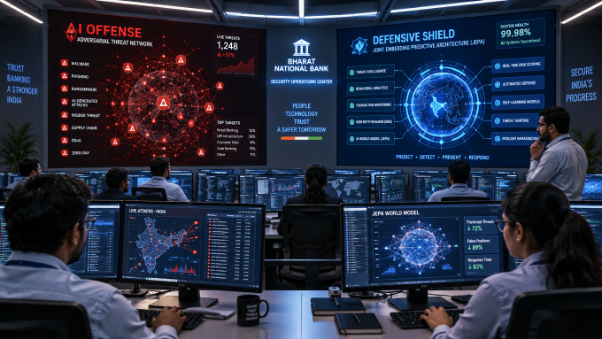
To combat machine-speed threats, banks must adopt the Joint Embedding Predictive Architecture (JEPA). Unlike generative AI, which is prone to hallucinations, JEPA is a non-generative, energy-based architecture. It protects the institution by predicting "abstract representations" of the banking environment rather than processing raw tokens or pixels. This architecture provides a decisive advantage: it enables deep behavioral monitoring without decrypting sensitive customer data. By evaluating structural metadata and behavioral trajectories in "embedding space," JEPA allows banks to satisfy the "Data Minimization" and "Purpose Limitation" requirements of Sections 4 & 5 of the DPDP Act. "The proposed IIDA JEPA World Model circumvents payload decryption entirely... it evaluates the structural metadata and behavioral trajectories of systemic network activity rather than reading transaction content."
90-Day "Human-in-the-Loop" Mandate
Transitioning to a state of cyber resilience requires an immediate execution matrix. The "Strategic Banking Preparedness Roadmap" identifies the first 90 days as the critical window for establishing an "Agent Privilege Matrix. "CISOs must move toward "least-privilege agent controls," which involves defining strict tool-execution boundaries to prevent excessive agent agency. Immediate deliverables include:
* Auditing Agent Permissions: Mapping all automated internal systems to ensure narrow scopes of action.
* Enforcing HITL: Implementing strict "Human-in-the-Loop" requirements for all high-value wire transfers. This fundamental shift ensures that while machines handle the high-frequency detection of threats, human judgment remains the final gatekeeper for high-risk financial movements.
Future of Resilience
The path forward for Indian financial institutions is a transition from reactive defense to structured cyber resilience. Through the efforts of IIDA Labs and the All Bharat Artificial Intelligence Association (ABAIA), the development of a "Sectoral Cyber Range" provides a necessary sandbox for adversarial simulation and stress-testing advanced JEPA-based world models. As the industry evolves, leadership must confront a difficult strategic tension: How do we continue to provide the unparalleled convenience of instant liquidity through UPI while implementing the "predictive world-model" security required to stop an autonomous adversary?