When Everyday Life Ran on Human Networks
For decades, everyday life in India ran on people, processes, handoffs, and trust. In the pre-liberalization era, owning a car or refrigerator was a privilege, while air conditioning was largely out of reach. Most homes had electricity; few had gas cylinders; televisions were usually black and white. Each morning, a milk seller arrived from a nearby village with large cans of fresh, often unpasteurized milk—one link in a deeply human supply chain.
The newspaper vendor followed, tossing the day’s paper onto the doorstep. Before 24-hour television, newspapers shaped the morning’s understanding of the world; broadcasts arrived only at scheduled times.
Then the day began. Adults walked, cycled, took public transport, or drove to work, usually carrying a home-cooked lunch. Children did the same for school, often traveling together in an auto rickshaw.
By evening, the pattern reversed: children returned from school, workers came home, and dinner took shape from ingredients bought at a neighborhood shop, a street market, or a vendor who came directly to the door. The details varied by family, but the rhythm was familiar across much of India.
Telephones and computers were uncommon, and the internet had barely moved beyond research institutions and large organizations. Bicycles and two-wheelers were more common than cars; horse carts and bullock carts still carried construction materials. Life was slower and simpler, but it depended on constant human coordination—one person handing work, goods, or information to another.
From Doorstep Handoffs to Digital Convenience
Fast-forward to 2026. Smartphones and mobile data now reach people across metros, smaller cities, and towns. Apps have absorbed many of the handoffs that once required a phone call, a visit, or a trusted intermediary. With a few taps, people can pay, travel, shop, or summon everyday goods—sometimes within minutes.
The needs themselves have not changed: children still go to school, adults still work or run businesses, and households still need food, transport, and services. What has changed is the infrastructure surrounding those needs—and how seamlessly technology now fits into daily life.
The Digital Public Infrastructure Beneath the Tap
Much of this shift rests on population-scale digital infrastructure built over the past decade and a half. Aadhaar, UPI, the JAM trinity, and the broader India Stack have helped establish India as a leading example of digital public infrastructure.
What a Simple QR Payment Really Requires
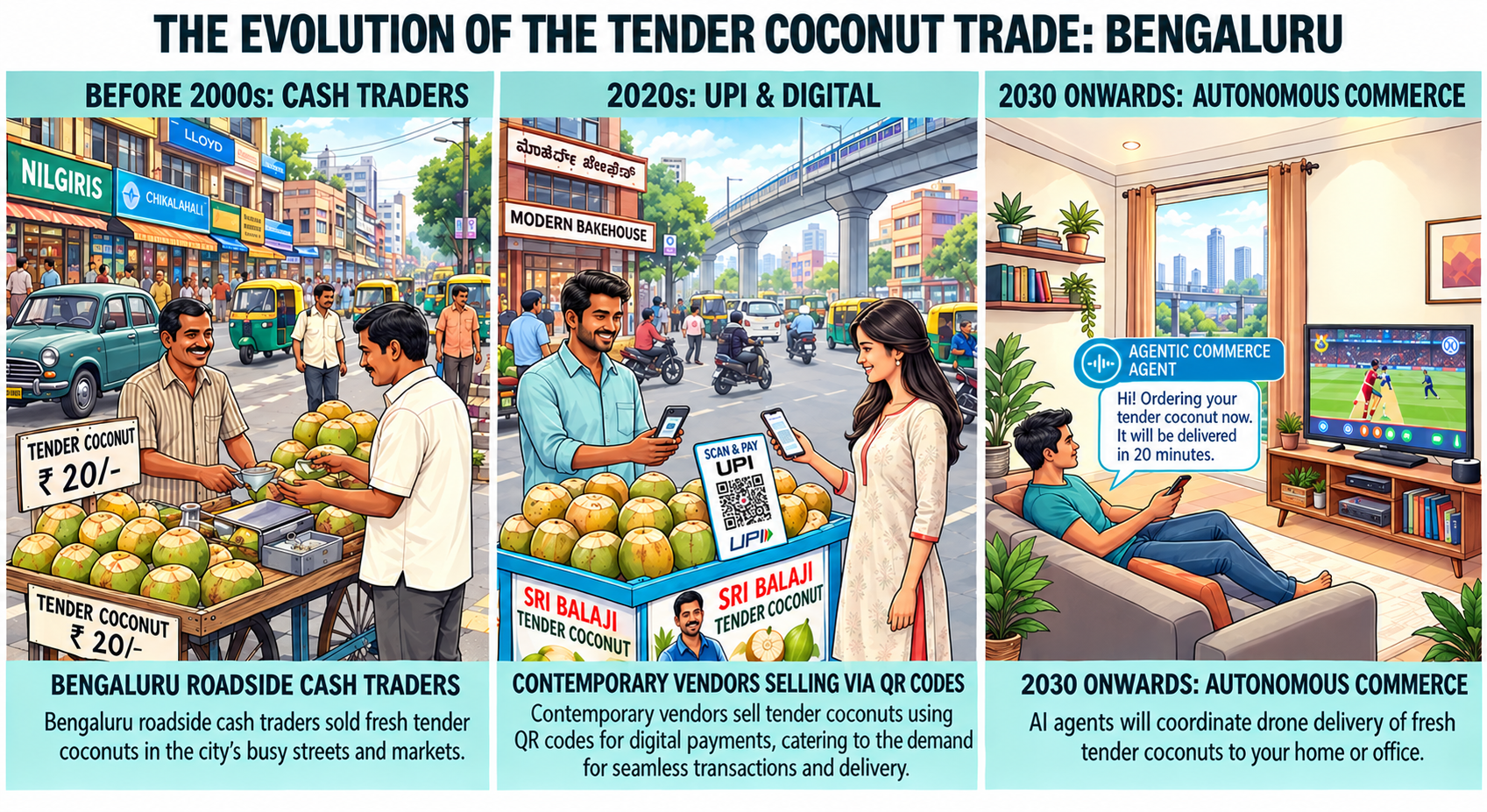
Consider the familiar act of buying a tender coconut. A customer scans a QR code, confirms payment, and moves on. That simple gesture depends on innovations developed across industries and decades: the QR code, originally created for manufacturing workflows; the smartphone camera; software that interprets the code; and the payment address embedded within it.
It also depends on interoperable hardware and software: cameras from different manufacturers, shared standards, and applications capable of recognizing and decoding the same symbol reliably.
Behind that sits the communications layer—mobile networks, fiber, towers, and global connectivity—plus the banking rails that move money almost instantly. What feels like one action is really an orchestration of many systems.
AI Agents Enter the Economic Loop
AI agents are poised to become the next participants in this system. These applications use models, tools, and feedback loops to pursue a goal on a user’s behalf. As they gain access to India’s digital public infrastructure, many interactions that occur today between a person and an app may instead happen agent to agent.
A Tender Coconut, Ordered Agent to Agent
Imagine telling a personal agent: “Deliver a tender coconut within 30 minutes, for no more than ₹100.” The request contains a goal, a deadline, and a spending limit. From there, the agent can begin planning.
Because it is a personal agent, it already knows who is asking, where the delivery should go, what is needed, when it is needed, and what payment method is authorized. It searches for nearby sellers, contacts their commerce agents, and asks which can meet the product, price, and delivery constraints.
The responses arrive with prices, availability, and delivery estimates. The agent ranks them, selects the best fit, authorizes payment within the agreed limit, and receives confirmation. Once fulfillment begins, it continues monitoring the order and shares tracking updates with the customer.
When the Real World Disrupts the Plan
The customer keeps watching a cricket match while the order travels across the city. A delivery robot encounters a temporary road closure and calculates a detour that will add 14 minutes. It reports the change to the seller’s agent, which immediately alerts the customer’s agent.
Now the system must negotiate a trade-off: keep the existing order and accept the delay, or place a replacement order that may arrive sooner. The business agent explains the disruption, the revised route, and the likely arrival time.
The customer’s agent asks for a decision: “Would you like me to place another order, or are you comfortable waiting a few extra minutes?” The customer chooses to wait. That preference travels back through the chain, and the delivery continues along the alternate route.
On arrival, the delivery agent notifies the seller, the seller’s agent notifies the customer’s agent, and the customer receives a pickup prompt. A home robot could even authenticate the handoff, collect the coconut, and bring it inside. The transaction is complete—without the customer leaving the couch.
From One Transaction to Billions
Now multiply that interaction billions of times. Buying a tender coconut is not new; grandparents did it from street vendors. What is new is the number of digital actors coordinating between intent and fulfillment—and the speed at which they can do so.
Era | Primary Interface | Underlying Infrastructure | Key Trust Mechanism |
|---|---|---|---|
Pre-2000s | Person-to-person (Doorstep/Market) | Manual handoffs, Cash | Local relationships & familiarity |
2020s | App/QR Code Scan | UPI, JAM Trinity, Mobile Networks | Encryption, Bank Rail Authorization |
2030s+ | Agent-to-Agent (Voice/Intent) | DPI + Open Commerce Networks + AI Agents | Digital Mandates, Zero-Trust Verifiable Credentials |
UPI: The Payment Rail for Agents
In the coconut example, the step that matters most is the payment, and in India that step runs on UPI. UPI handled 24.5 billion transactions in August 2026 alone, and it accounts for nearly half of the world’s real-time digital transaction volume, so any agent that buys things for people will need to work with it. India is moving in that direction. NPCI is reportedly developing a Unified Agent Protocol so that AI agents can be registered, verified, and authorized to transact across UPI without changing the underlying payment rails. The design reportedly builds on existing features such as UPI Circle and Reserve Pay, which let users delegate payment authority to an agent within a pre-set limit. Customers would set rule-based instructions on when and how much an agent can pay, with built-in spending limits, audit trails, and identity checks. This is the narrow, time-bound authority described below, built into the payment network itself, so a ₹100 coconut order would not need a fresh approval at every step. Because the protocol is still being reported on rather than formally rolled out, the details may change before launch.
Securing Every Handoff by Design
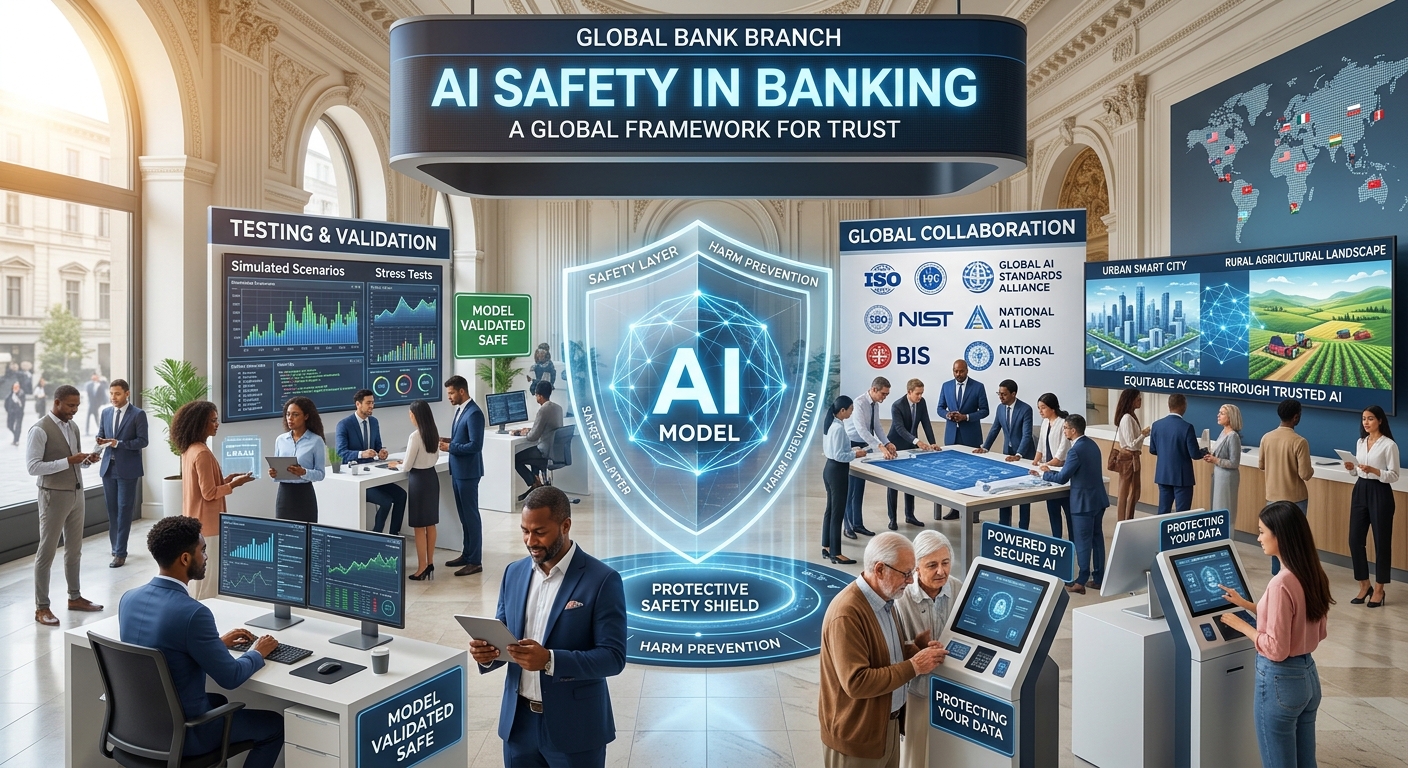
In this future, AI will not secure the transaction through a single checkpoint. It would create a chain of trust across every handoff—from the customer to the personal agent, from that agent to the seller, from the seller to the payment network and delivery system, and finally from the courier or robot back to the customer. Each participant would need to prove who or what it is, what it is allowed to do, and whether its request fits the customer’s original intent.
- Verifiable identity - People, businesses, devices, and agents could use trusted digital credentials to authenticate themselves without exposing more information than necessary. The customer’s agent might confirm that a seller is registered and that a delivery robot belongs to an approved operator, while the seller could verify that the requesting agent has a valid mandate from the customer. This mutual verification would make impersonation, counterfeit storefronts, and unauthorized agents harder to introduce into the chain.
- Narrow, time-bound authority - Instead of giving an agent open access to a bank account or a complete personal profile, the customer could grant a specific permission: buy one tender coconut, spend no more than ₹100, deliver it to an approved location, and complete the task within a defined period. The agent could not extend that authority to another purchase, raise the spending limit, or disclose the address for a different purpose without fresh approval.
- Continuous Transaction Monitoring - AI could then monitor the transaction continuously rather than checking only at payment. Risk models could compare the request with the customer’s normal patterns, detect an unusual seller or device, flag a sudden price change, identify repeated routing anomalies, or pause a handoff if two systems report conflicting information. Low-risk actions could proceed automatically; higher-risk exceptions could trigger step-up authentication or a direct question to the customer.
- Privacy - would also need to travel with the task. Each participant should receive only the minimum information required for its part of the job. A seller may need the product request and proof of payment, while a delivery service may need a temporary destination token rather than permanent access to the customer’s full profile. Sensitive data could remain encrypted, and access could expire when the handoff is complete.
- Tamper-evident record - Every consequential action should also leave a tamper-evident record: which agent acted, which credential it presented, what authority it used, what information it shared, why it selected a seller, and when a human approved an exception. These records would support dispute resolution and accountability without requiring every participant to see the customer’s private data. They would also let independent systems test whether an agent followed policy or quietly exceeded its mandate.
The final handoff would need the same rigor as the first. The delivery agent could present a one-time proof of arrival, the receiving person or home robot could confirm possession, and payment could be released only when the agreed conditions are met. If the coconut is missing, late, or delivered to the wrong place, the agents could use the shared record to determine what failed, reverse or hold payment where appropriate, and route the case to a person.
Trust, then, would come from more than accurate AI. It would come from a system in which authority is explicit, data exposure is limited, risky behavior is challenged, decisions can be inspected, and people retain the right to pause, override, or appeal. AI can make each handoff faster, but these controls are what would make the entire chain dependable at scale.
Governance Has to Be Designed In
Technical safeguards only work if they rest on clear rules about who is accountable. Experience from regulated financial systems, from KYC onboarding to tax compliance, shows that compliance holds up best when regulation is translated into the system itself rather than added afterwards. Agentic commerce needs the same discipline. Agent identities and mandates should work like KYC for software: a verifiable link between an agent and the person or business it represents, with clear liability when something goes wrong. Audit trails should be readable by regulators and auditors, not only by engineers. Decisions that affect people, such as why one seller was chosen, why a payment was held, or why a transaction was flagged, should be explainable in plain terms. And rules for consent, grievance redress, and human override should be agreed with regulators early, so that scale does not outrun oversight.
Trust Is the Real Infrastructure
That convenience comes with responsibility. Every layer must be secured against data theft, fraud, unauthorized delegation, and abuse—especially when public digital infrastructure serves people at national scale. The future of agentic commerce will depend not only on what agents can do, but on whether people can trust the identities, permissions, payments, and decisions flowing between them.
Key Takeaways
- Shift in Handoffs: India's commerce evolution moves from human trust to app-based convenience, and soon to autonomous AI coordination.
- Agentic Loop: Future transactions won't just be automated payments; AI agents will actively discover, negotiate, re-route, and execute tasks based on user constraints.
- Security by Design: Scaling agentic commerce requires explicit user mandates, minimal data exposure, real-time risk checks, and verifiable audit trails.