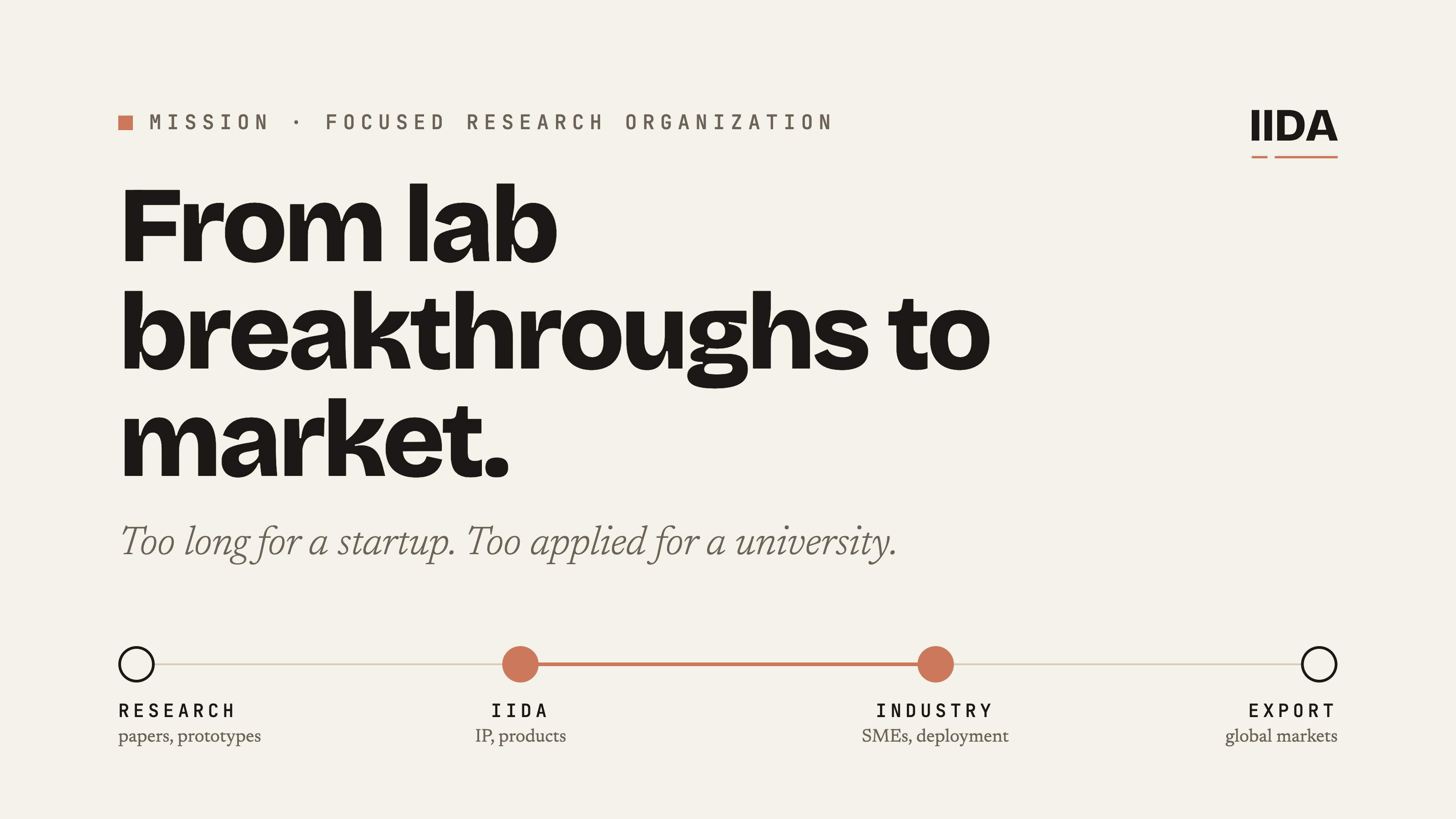
India does not have a research talent problem. Indian researchers publish at the frontier, and Indian engineers build much of the software the world runs on. What India lacks is a dependable way to turn that research into things people pay for: patents, products and exports.
IIDA, the Innovators & Industry Deeptech AI Alliance, is being built to close that gap. This post sets out the mission in plain terms, explains what a Focused Research Organisation is, and names how we will know whether it is working.
The mission, in one sentence
To translate breakthroughs in deeptech, AI research and scientific discovery into societal impact, wealth creation and industrial competitiveness.
The vision that follows from it is longer-term: a platform for open innovation, industry science and applied AI research, built on owned IP, shared infrastructure, industrial deployment and export-led growth in AI products and services.
Mission statements are easy to write. The rest of this post is about the parts that make this one testable.
Why research stalls between the lab and the market -
Compare how three countries move research into the economy.
- The United States commercialises long-horizon research through close links between universities, industry and capital.
- China ties research to industrial policy and manufacturing scale.
- India has comparable talent and fewer mechanisms for converting research into IP, products and exports.
The gap is structural, and it sits in a specific place. Consider who decides what gets worked on:
- Venture capital prefers shorter payback than a five-year research horizon allows. That is a fund-cycle constraint, not a lack of ambition.
- Universities reward publication and placement. Large, cross-disciplinary engineering projects with a low chance of a publishable paper are exactly what academic incentives discourage.
- Industry wants a quick return, which is what industry is for.
Between them sits a band of problems that are commercially real in three to five years. Too long for a startup, too applied for a university. Everyone can see these problems. Nobody's incentives point at them. That band is IIDA's whole brief.
What is a Focused Research Organisation?
A Focused Research Organisation (FRO) is a purpose-built non-profit that takes on bottlenecks too engineering-heavy for an academic lab and not immediately profitable enough for venture capital. It is time-bound, it hires full-time, it works to a defined mission, and it releases its output openly.
IIDA applies that model to one segment: applied AI research that can scale commercially within three to five years, aimed at small and medium enterprises and aligned to India's IT services and product exports.
Six properties separate this from a typical research centre:
1. Time-bound. Three-year research horizons with exit conditions agreed in advance, not open-ended mandates.
2. Owns its assets. The IP and the equipment sit with the organisation. IIDA does not broker other people's work and take credit for the introduction.
3. Self-sustaining. After initial capital, the target is at least 30% of revenue from industry contracts by Year 2 — the discipline Fraunhofer is known for, not a grant habit.
4. SME and export focused. A chosen market, not a general research mandate.
5. Specialised. Engineers and technical builders working deeply on few problems.
6. Plugs in. It builds on existing public systems and aligns with government and UN goals instead of duplicating them.
What "lab to market" means in practice -
A lab-to-market claim is only useful if you can say what the market is. For IIDA, it is Indian SMEs and export buyers with problems that are expensive and still manual.
That is why the problem bank matters as much as the research tracks. A company describes what breaks, how often, and who absorbs the cost. We screen each problem against a specific economic threshold, because a problem worth solving has a number attached to it. Submissions can be anonymous, and nothing is published without consent.
The research side currently runs below tracks:
How we will know if it is working -
A mission is only as credible as its measures. Three commitments make ours checkable.
A public scoreboard. Papers published, open releases shipped, institutional partners signed. It is dated and updated monthly, and at launch every figure on it was zero. We publish the count before there is anything to count, because a dated zero is more credible than an undated claim. See the scoreboard.
Funding that cannot buy direction. A patron has no editorial control over research output, cannot direct hiring or specific research questions, and every rupee is audited with an annual conflict-of-interest disclosure. The details are on the governance page.
An honest status. IIDA is an initiative of ABAIA, the All Bharat Artificial Intelligence Association, and sits within the ABAIA Industry & Innovation Foundation, a Section 8 company. We do not claim 12A, 80G or FCRA status. No Scientific Director has been appointed and no paper has been published yet. The risk register, "eight ways this fails", is on the about page.
A staged path, not a big launch -
The FROs worth learning from run on $50–100 million over five to seven years. Starting at that scale from nothing is not a plan. IIDA's path has three steps:
1. A hybrid entity. A consortium, a challenge fund and a Section 8 research node, rather than waiting for a single philanthropic underwriter.
2. Layered contracts. State-backed pilots and specific industry contracts that solve real problems while research capacity is built.
3. Financial discipline. At least 30% of revenue from industry contracts by Year 2, so the organisation never becomes grant-shaped.
Why start now -
Two dates frame the work. China has set 2041 as a target for artificial general intelligence. India reaches its centenary in 2047, around when its demographic dividend is projected to end. The window in which research-led deeptech can compound into national capability is roughly the length of one career.
India has built an industry through an alliance before. In 1988, thirty-eight companies founded NASSCOM as a not-for-profit industry body, and the software-export sector it helped shape grew from about $100 million to more than $250 billion. We think a similar mechanism can work for deeptech and applied AI.
That is not a reason to rush the hard parts. It is a reason to start the slow parts now.
Frequently asked questions -
What does IIDA stand for ?
IIDA stands for Innovators & Industry Deeptech AI Alliance. It is a Focused Research Organisation incubated by ABAIA, the All Bharat Artificial Intelligence Association.
Is IIDA a non-profit ?
Yes. IIDA sits within the ABAIA Industry & Innovation Foundation, a Section 8 company. It does not currently claim 12A, 80G or FCRA status.
What is IIDA's mission?
To translate breakthroughs in deeptech, AI research and scientific discovery into societal impact, wealth creation and industrial competitiveness, with a focus on India's SMEs and export markets.
How can I get involved?
There are four routes: lead a research track, bring a university partnership, submit a problem to the problem bank, or fund and make introductions as a patron. All are listed on get involved.
If something in your organisation is expensive and still manual, tell us about it in the problem bank. If you want to lead research, every track is still looking for a lead.